
In the digital age where data becomes a strategic asset,3D object scanningis no longer a frivolous technology trend but has become a bridge between the physical world and the digital world. This 3D scanning technology helps businesses transform all products, samples, mold details, or the current state of a project into measurable, storable, and analyzable digital data. As businesses transition their processes to a digital platform,3D object scanningis one of the key foundations for creating digital models, quality management, and facilitating automation — because3D object scanningallows for capturing the true shape of objects with a level of detail that the naked eye and traditional measuring tools can hardly achieve.
Not only for the manufacturing industry,3D object scanningalso opens doors for architecture, heritage preservation, e-commerce, and AR/VR customer experiences: businesses can showcase digital products, simulate assembly, or create digital sample libraries. In summary, technology is a strategic tool for businesses that want to standardize physical data, shorten design cycles, and enhance competitiveness. Looking towards the future of Digital Twin, BIM, and automation processes, the role of3D object scanningwill only increase, not decrease.
I. What is 3D object scanning?
1. Definition
3D object scanningis the process of collecting geometric and surface data of a real object in three-dimensional space using specialized equipment, then converting that data into a digital model — point cloud or mesh. When you need a faithful digital copy of an object,3D scanning of objectsis a method to 'copy' the shape, size, and surface details with high resolution.3D scanning of objectsallows for the preservation of the real entity in the form of data, serving reverse engineering, size inspection, and reproduction through 3D printing.
2. Main operating principles
There are many ways to perform3D scanning of objects, but at its core, the methods rely on projecting signals (light, laser) onto the object and recording the feedback to calculate spatial coordinates:
Laser triangulation: emits a laser beam, camera measures beam deformation;3D scanning of objectsin this way has high accuracy, suitable for measuring small details.
Structured light: projects patterns (grid/ stripes) and then analyzes the deformation of the pattern; a fast method ideal for3D scanning of objectswith complex surfaces.
Photogrammetry: takes multiple photos from different angles, software calculates common points; this is a popular way to 3D scan large objects or when low cost is needed.
Industrial CT/X-ray: used for3D scanning of objectsneeds to survey the internal structure (non-destructive), for example, inspecting molds or complex components.
These principles turn physical surfaces into digital data —3D scan of objectscreating point clouds, meshes, and ultimately can export to CAD files for editing or exporting to CAM/CNC software.
See more>>>>>Harnessing the power of 3D Laser Scanning technology: The foundation for BIM and Digital Twins
3. Types of devices and cost levels — businesses should know
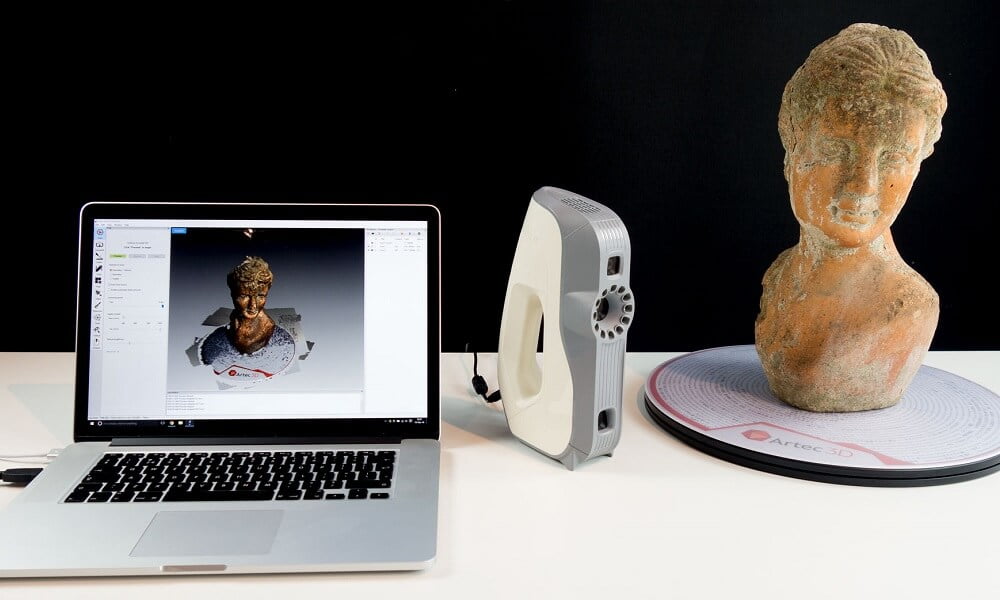
Handheld scanners:flexible, suitable for3D scanning of objectsof medium size—from machine parts to product design.
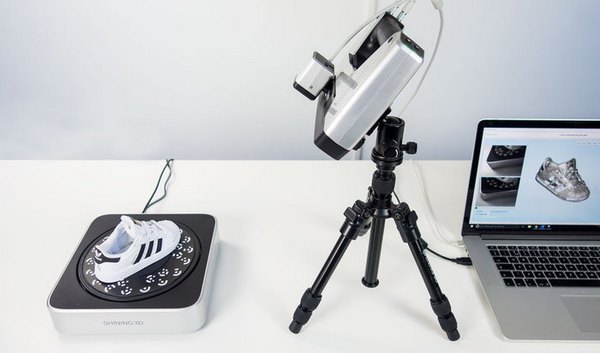
Desktop scanners:suitable for3D scanning of objectsas small as jewelry details, spare parts.
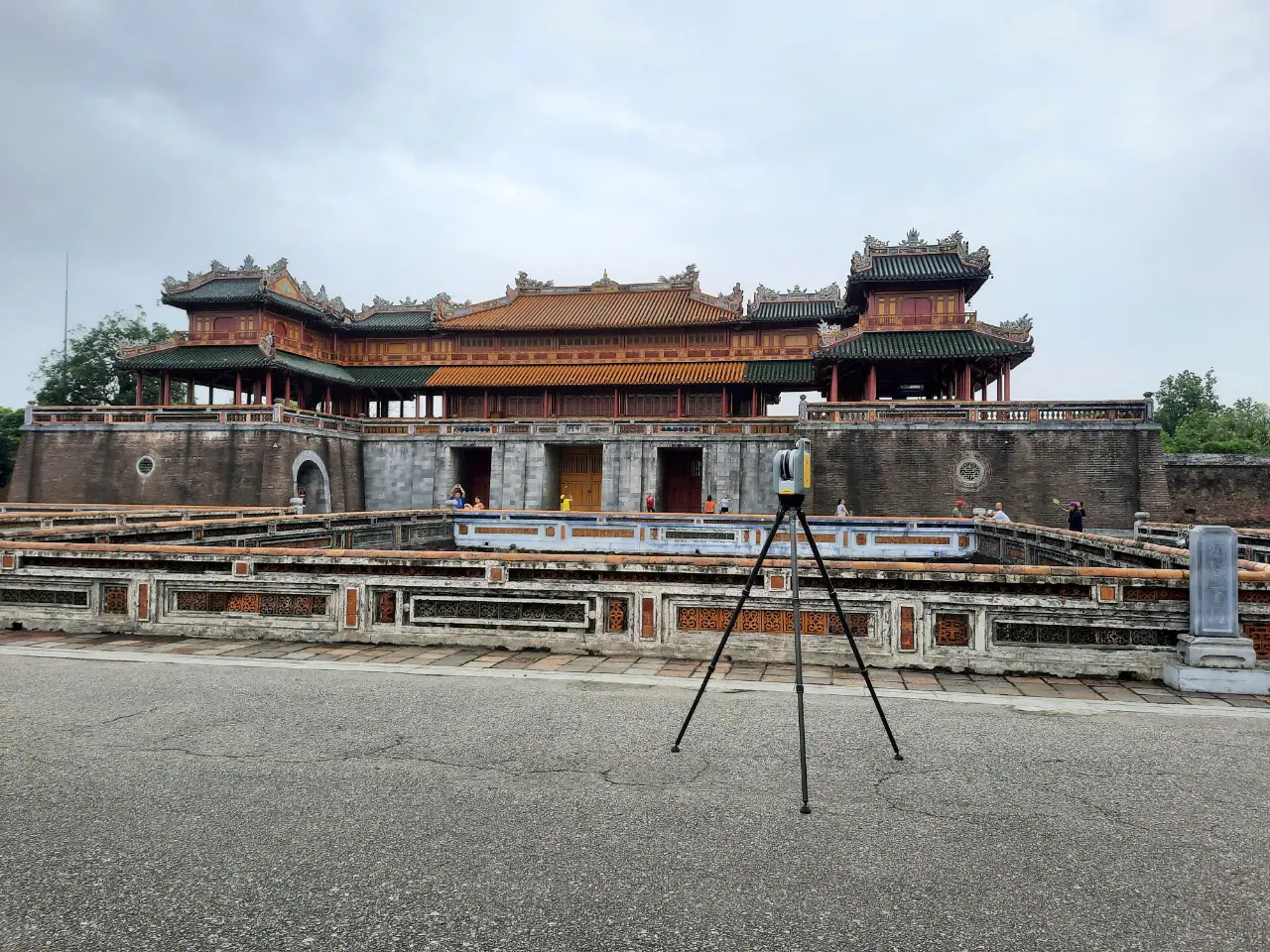
Building laser scanners / terrestrial LiDAR:used to3D scan of objectson a large scale (such as structures, factories).
Photogrammetry systems (camera kit + software):lower cost, allows for3D scanning of large objects with acceptable resolutionlarge with acceptable resolution.
Industrial CT systems:high cost, but allows for3D scanning of internal objects, important for in-depth quality inspection interior, important for in-depth quality inspection.
The investment decision depends on the goals: if the business needs 3D scanning of objects for reverse engineering and size checking with an error of ≤ 0.1 mm, then a high-precision scanner should be chosen; whereas if the goal is to display digital products or create AR content, photogrammetry or a general-purpose handheld scanner may be sufficient.
See more>>>>> Popular types of 3D scanners today
4. Output results when scanning a 3D object
Upon completing the 3D object scanning process, the business will receive:
Point cloud: a collection of XYZ coordinates, is the foundation for all subsequent steps.
Mesh / STL / OBJ: triangular mesh that can be used for 3D printing, simulation, or 3D presentation — a common result when 3D scanning an object for web product display.
CAD data (after modification / reverse engineering): used for production, CNC machining, or redesign — the ultimate goal if the purpose of 3D scanning the object is to integrate it into the production process.
BIM / Digital Twin inputs: when scanning a 3D object at the project level, the data can be input into the BIM system for asset lifecycle management.
See more>>>>> 3D scanning technology and the reasons why it is ahead of its time?
II. Application of 3D Object Scanning in Enterprises — From Production to Digital Experience
1. 3D Object Scanning Application in Production & Process Optimization
In the context of lean manufacturing and automation, 3D scanning of objects not only stops at collecting initial surface data but also provides strong support in engineering simulation, interference checking, and tolerance analysis before moving to mass production. When the depth data of the object is digitized in 3D, the engineering team can input the model into CAM (Computer-Aided Manufacturing) or CNC software to plan machining, optimize the layout of measurement fixtures, and assembly processes in a visual and accurate manner.
The integration of3D scanning of objectswith the platformof digital manufacturing simulationhelps businesses reduce machining errors, save materials, and decrease mold testing time. This is particularly useful when producing complex parts that require extremely tight tolerances. Many studies and real-world reports show that businesses using 3D scan data in the preparation and simulation of production canreduce operational costs by 20–30% in the long term, especially when aiming for aSmart Factoryand smart manufacturing.
See more>>>>>3D Scanning: A technology that goes from idea to revolution in manufacturing and design
2.3D scanning of objectsin construction, architecture & BIM
In the construction and architecture industry,3D scanning of objectshas become a foundational technology for creatingBIM (Building Information Modeling)accurately from the actual current state. In large-scale projects, manual measurement using traditional methods is both time-consuming and prone to errors; while3D scanning of objectsallows for comprehensive data collection of the current state of the structure, includingstructure, topography, and technical details, which can then be converted into high-quality BIM models. When this data is imported into BIM software, architects and engineers can collaborate on design, predict conflict points, and optimize construction from the early stages.
According to data from Autodesk, applying3D scanning of objectsin the BIM process can help reduce up to40% of design conflicts and out-of-scope changes, which often cause delays and additional costs during actual construction. Additionally, in renovation or heritage restoration projects,3D scanning of objectsis an almost irreplaceable method for collecting geometric data of existing components before intervention.
 See more>>>>> Applications of 3D scanning in various industries
3.3D scanning of objectsin marketing, sales & digital customer experience
In the era of digital commerce, consumer behavior has changed significantly: customers not only want toseethe products, but also want toexperience them before making a purchase decision.3D scanning technology has become the "golden key" that helps businesses recreate products in the digital space with high realism. From the obtained geometric data, interactive 3D models allow users to rotate 360 degrees, zoom in on details, and observe texture, size, and scale — something that 2D images struggle to convey fully.
These digital models can be integrated into e-commerce websites, online marketplaces, AR/VR applications, electronic catalogs, or virtual showrooms. When customers can "hold - rotate - observe" products in the digital environment, the level of trust increases significantly. According to Shopify and Google AR, 3D content and augmented reality experiences helpincrease time spent on the page by 2–3 timesandraise conversion rates from 40% to over 90%, particularly effective in retail, furniture, fashion, industrial equipment, and real estate sectors. Not only does it boost sales, but 3D modeling also helpsreduce product return rates. When buyers clearly understand the size, shape, and structure from the beginning, expectations are set more accurately, limiting return and operational costs. For large businesses, just reducing the return rate by 1–2% can bring significant savings.
In the B2B segment, 3D spatial data helps present machinery, components, and technical lines visually, supporting faster and more accurate consultations. Sales teams can use tablets or VR glasses to simulate products instead of transporting bulky samples, increasing persuasiveness and professionalism. For the B2C market, this technology opens up new forms of experiences such asvirtual showrooms, product testing with AR, showcasing furniture in real spaces, or livestreaming with 3D models.Consumers can place a virtual sofa in the living room, try on a watch on a digital wrist, or observe the details of each product — an experience that is both emotional and accelerates purchasing decisions.
See more>>>>>The 3D scanning service at Star Global provides optimal efficiency.
4. Applications3D object scanningin the preservation, restoration, and digitization of heritage.
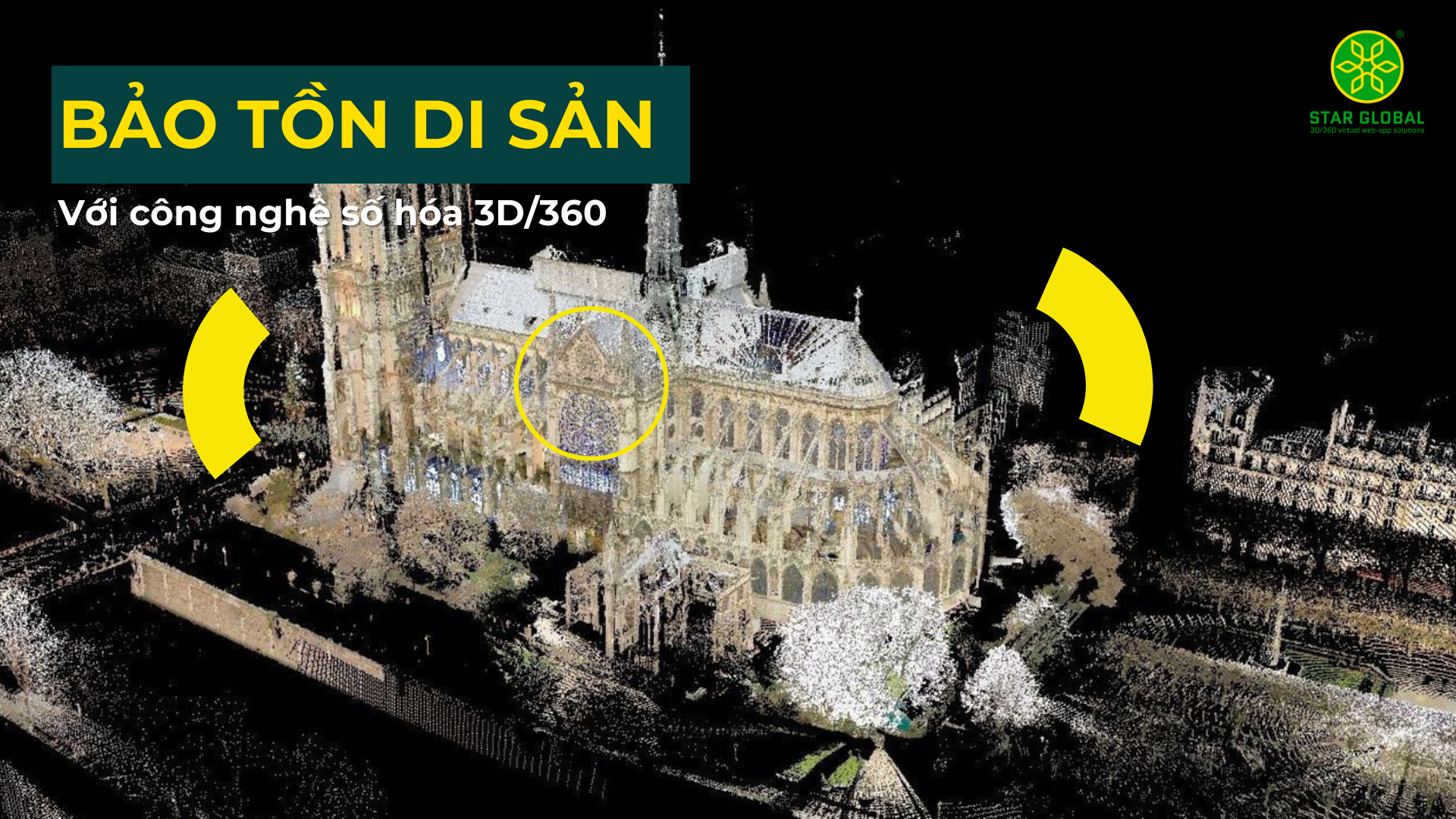
In the field of heritage preservation,3D scanning technologyis seen as a silent yet revolutionary breakthrough. Instead of relying on paper records, hand-drawn sketches, or 2D photographs that are prone to distortion and lack spatial depth, three-dimensional digitization allows for the accurate capture of the shape, size, patterns, and original condition of artifacts with near-absolute precision. Each scanning session is a moment of 'freezing time,' helping to preserve the current state of heritage against the harsh impacts of climate, environment, and natural erosion.
For valuable artifacts such as ancient statues, reliefs, ceramics, traditional musical instruments, or wooden architecture, 3D data provides the ability to reproduce every micro-detail that is difficult to observe with the naked eye. According to UNESCO, 3D digitization has now become a priority method in heritage preservation, especially in areas at high risk of deterioration or frequently affected by natural disasters. Thanks to non-contact scanning systems, experts can analyze structures, measure damage levels, and develop scientific preservation plans without harming the original artifacts.
Not only limited to physical preservation, 3D scanning also opens the door todigital preservation and heritage education.. The artifacts, once digitized, can be integrated into digital museums, 3D/360 virtual exhibitions, or online learning platforms. Users can rotate, zoom in, and observe the intricate details of the artifacts directly on digital devices — a visual experience that traditional display spaces find hard to provide. According to statistics from Google Arts & Culture, 3D heritage digitization projects significantly increase the number of people accessing heritage compared to the physical limitations of museums.
Especially in Vietnam — where many tangible heritages are under pressure from urbanization and climate change — the 3D scanning solution is seen as a sustainable approach to preserving the cultural “essence” for future generations. Digitizing artifacts, structures, and heritage spaces not only serves conservation purposes but also lays the foundation for the development of digital tourism, academic research, heritage communication, and promoting the national image on a global platform. It can be said that this technology is a delicate bridge connecting the past, present, and future of humanity's heritage.
 See more>>>>> Experience the Ho Chi Minh City Smart Museum 3D/360
III. Why can 3D scanning of artifacts accurately recreate the real world in a digital environment?
The core of the technology3D scanning of artifactslies in the ability to collect and accurately recreate the spatial shape of an object in a digital environment. By capturing millions of data points in three-dimensional space, the 3D scanning system builds a highly detailed digital replica that faithfully reflects the size, scale, and structure of the artifact.
This process not only serves the goal of visualizing images but also creates foundational data for systems3D/360 digitization, digital displays, heritage storage, online training, and simulating digital spaces.
1. Accurately determine the position and size of each detail
When scanning 3D objects, the scanning device uses lasers, structured light, or multi-angle cameras to record the position of each point on the object's surface. Each data point carries information about spatial coordinates and distance from the sensor.
Thanks to the precise spatial measurement mechanism:
The distance from the device to each surface is automatically calculated.
Height, depth, curvature, and profile are clearly defined.
The overall shape of the object is reconstructed intoa 3D point cloud..
Businesses and digitization units can be assured that the digital model accurately reflects the actual state, avoiding discrepancies when displaying, storing, or reusing data for 3D/360 platforms.
See more>>>>>> What is a Point Cloud? 5 facts about Point Cloud
2. Faithfully recreate the surface and structure of the object
After collecting point data, the 3D scanning software processes it to link the points into a continuous surface and a complete solid model. The modeling algorithms will:
Connect point data into a surface mesh.
Smooth the surface, removing noise and distortions.
Maintain the correct size ratio compared to the original object.
The resulting 3D model can accurately reflect:
The overall shape.
Surface details.
Structural features of the object.
The 3D scan data of the object is reliable enough for application in3D/360 digitization., preserving heritage, building digital museums, visual training, interactive presentations, and promoting images in the digital environment.
3. Combining multiple scans to create a complete and seamless model.
In practice, an artifact often needs to be scanned from multiple angles to ensure no details are missed. The 3D Scan system will automatically align and synchronize the datasets obtained from multiple scans.
This process helps:
Merge data layers into a unified model.
Eliminate duplicates or discrepancies.
Ensure continuity between surfaces.
A complete 3D model, free from data 'breaks', enhances reliability when deployed on 3D/360 platforms, especially in digital exhibitions, virtual reality experiences, and online training systems.
4. Optimize data for smooth display on 3D/360 digital platforms.
A high-quality 3D model not only needs to be accurate but also optimized for size and display performance. After scanning the artifact in 3D, the data is further processed to:
Reduce the model size while retaining important details.
Optimize display surfaces for web browsers, mobile devices, VR/AR.
Standardize scale and multi-platform compatibility.
Users can experience smooth 3D/360 models, fast loading, stable interaction, suitable for virtual tour systems, digital museums, digital exhibitions, and smart experience platforms.
5. Enhance measurement, analysis, and exploitation of digital data.
An important value of 3D scanning artifacts lies not only in the visual images but also in the ability to exploit technical data:
Measure dimensions accurately.
Analysis of shape, volume, and deviation.
Reconstruction, simulation, and long-term storage.
Digital data can be reused multiple times, serving research, training, communication, preservation, and the development of digital products. Businesses build a sustainable digital data ecosystem, helping to optimize operational costs, enhance the value of digital assets, and expand the application of 3D/360 technology in the long term.
See more>>>>> Preserving the sacred – 3D scanning and recreating ancient sculptures
Conclusion:
In the context of strong digital transformation occurring in all fields,3D scanning of artifactshas gone beyond the role of a mere technical technology to become a strategic foundation in asset digitization, value preservation, operational optimization, and enhancing user experience. The implementation of3D scanning of artifactshelps create highly accurate data models, effectively serving 3D/360 displays, heritage preservation, research – training, reverse design, as well as developing digital content platforms and intelligent interactive ecosystems.
As a technology company that hasapplied 3D scanning of artifacts early on, Star Globalcontinues to improve the digitization process, mastering equipment, processing software, and multi-platform integration capabilities. From the dataof 3D scanning of artifacts, Star Global builds 3D/360 digital spaces, integrating AI Virtual Assistants, creating intuitive, vivid experiences with long-term exploitation value for businesses, regulatory agencies, and the cultural – tourism sector. Systematic and sustainable investment in3D scanning of artifactshelp Star Global gradually assert its pioneering role in digital transformation, contributing to the dissemination of Vietnamese technology values and shaping the future of the digital content ecosystem in Vietnam.